

Custom Spa Covers: Why a Perfect Fit Matters for Your Hot Tub
Struggling with a cover that's heavy with water, leaks heat, and lets debris sneak in? That's exactly why custom spa covers exist. A hot tub is a real investment, both financially and in terms of the lifestyle it brings. But too many owners settle for off-the-shelf covers that were never designed with their specific spa in mind. The result? Higher energy bills, faster cover deterioration, and a lot of frustration every time you want to take a soak.
Custom spa covers are purpose-built to address exactly these problems. From irregular shapes to specialty foam densities, a cover made specifically for your hot tub does everything a generic one simply can't. In this guide, we're breaking down what makes a custom cover worth every penny, what to look for when shopping, and how the right fit can extend the life of both your cover and your spa.
What Sets Custom Spa Covers Apart from Standard Options
Walk into any big box store and you'll find spa covers stacked in a few standard sizes. They're priced to move, and at first glance, they seem like they'd do the job. But here's the reality most salespeople won't tell you: hot tubs come in hundreds of different shapes, corner radii, and cabinet heights. A cover that's even an inch too short on one side can cost you significantly in heat loss over a single winter season.
Custom spa covers are measured and built to your exact tub dimensions. That means the foam core fits flush, the skirt hangs at the right depth, and the seams sit where they're supposed to. There's no guesswork, no shimming it into place, and no compromising on performance. Beyond dimensions, customization extends to the materials themselves, vapor barriers, foam densities, cover weights, and vinyl grades can all be tailored to your local climate and how often you use your spa.
The Real Cost of a Poor-Fitting Spa Cover
It's tempting to think of a spa cover as a one-time purchase where saving a little upfront makes sense. But economics tells a different story. A standard cover that doesn't fit properly will start absorbing water faster, because gaps allow moisture in, and a waterlogged cover can add 50 to 100 pounds of dead weight to your tub's frame while doing almost nothing to retain heat. You end up running your heater longer, replacing the cover sooner, and potentially straining your spa's cabinet and plumbing from the constant weight.
When you factor in the energy costs alone, a quality custom spa cover typically pays for itself within its first two heating seasons. That's before you even account for the reduced maintenance, extended equipment life, and the simple convenience of a cover that lifts cleanly and seals properly every single time.
Key Features to Look for in Custom Spa Covers
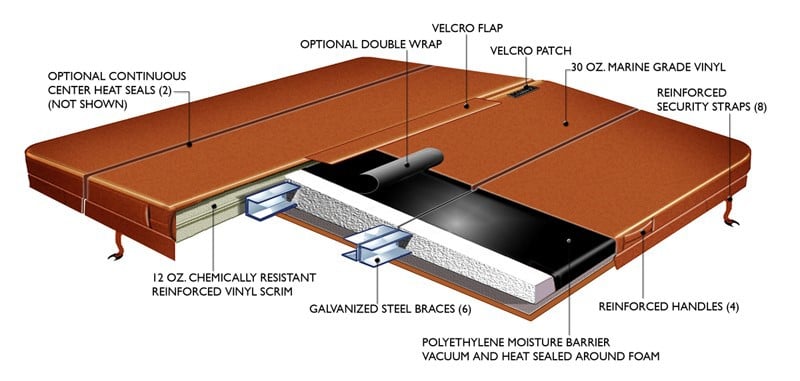
Not all custom covers are created equal. When you're shopping, here are the features that genuinely matter:
Foam Core Density and Taper
The foam is the heart of your spa cover's insulation. Look for a tapered foam core, typically 4 inches at the center tapering to 2 inches at the edges. This design sheds water from the middle outward, which is critical for preventing that waterlogging problem mentioned earlier. For colder climates, a 2 lb. density foam provides solid insulation; if you're in a harsher northern climate or leave your tub running year-round, consider stepping up to a 2.5 lb. or 3 lb. density foam.
Heavy-Duty Vapor Barrier
Every foam panel in a quality custom spa cover should be individually wrapped in a sealed vapor barrier, typically 6 mil poly sheeting. This is what keeps the steam and moisture from your spa water out of the foam. Without it, even the best foam will eventually become saturated. The vapor barrier is one of those unsexy features you never notice when it's working and absolutely hate yourself for skipping when it isn't.
Marine-Grade Vinyl Exterior
The outer vinyl is what takes the brunt of sun exposure, rain, snow, and general abuse. Marine-grade vinyl, typically 32 oz. or higher, is UV-stabilized and resistant to cracking, fading, and mildew. Cheaper covers use thinner, non-stabilized vinyl that starts peeling and cracking within a season or two of UV exposure. If your spa is in direct sunlight for large parts of the day, this is not a place to cut corners.
Reinforced Hinge and Handle Design
The hinge is one of the most failure-prone parts of any spa cover. A custom-built cover should feature a reinforced center hinge with a protective flap that keeps water and debris from getting into the foam at the fold point. Handles should be stitched through the vinyl and attached to the foam reinforcement board, not just stapled to the exterior skin. If the handles feel flimsy during the sales process, they'll feel worse after a year of daily use.
How to Properly Size Your Custom Spa Cover
Measuring for a custom spa cover is more involved than just measuring the length and width of the tub's opening. You need to account for the corner radius, the curve at each corner of the tub, because a cover with square cut corners on a rounded tub will have visible gaps and allow heat to escape. Measure the radius of each corner (most fall between 3 and 6 inches, but some spa designs go larger), and note whether all four corners are the same.
You'll also want to measure the cabinet height and determine the right skirt length for your model. The skirt is the vinyl flap that hangs down the side of the tub and helps create a seal against the elements. A skirt that's too short leaves a gap at the cabinet line; one that's too long will drag and wear out faster. Most manufacturers of custom spa covers will walk you through their measurement guide, and many offer templates specifically for popular hot tub brands.
Custom Covers for Uniquely Shaped and In-Ground Spas
One of the strongest arguments for going custom is if your spa falls outside the standard rectangle or square footprint. Octagonal spas, round spas, L-shaped spas, and in-ground or partially in-ground installations simply cannot be covered properly with a stock product. These setups are exactly where custom spa covers earn their reputation. A manufacturer that specializes in custom builds will work from your measurements, or in some cases your actual template, to produce a cover that fits like it was born there.
In-ground spas present their own unique considerations. Without a cabinet to reference, the skirt design changes, and the cover may need additional tie-down hardware to prevent wind from getting under it. A custom cover builder with in-ground experience will understand these nuances in a way that a generic manufacturer simply won't.
Matching Your Custom Spa Cover to Your Climate
Climate should be a primary factor in how you spec your custom spa cover. If you're in the Pacific Northwest or the upper Midwest where you see heavy snowfall, you want a cover built to carry a meaningful snow load without bowing or cracking. That means a thicker aluminum reinforcement channel inside the foam panels and a higher-density foam that won't compress under weight.
For those in the Sun Belt states, Arizona, Florida, Texas, and similar, the priority flips. UV resistance in the vinyl and lighter-weight foam that stays easy to remove daily becomes more important than snow load capacity. Some spa owners in hot climates also opt for a lighter color vinyl to reduce heat absorption and prevent the cover surface from becoming uncomfortably hot to handle.
Getting the Most Out of Your Custom Spa Cover
Even the best custom spa cover will age faster than necessary without basic maintenance. Every few months, apply a quality vinyl protectant to the exterior, look for one that's specifically formulated to be safe around spa water, as petroleum-based products can off-gas into the tub. Rinse the underside of the cover regularly to remove any chemical buildup from your spa water, and check the vapor barrier seals annually for any signs of cracking or separation.
A cover lifter is one of the smartest accessories you can pair with a custom spa cover. Not only does it make removing and replacing the cover effortless, it also takes the cover fully off the tub when you're soaking, preventing the steam from deteriorating the vinyl underside from the inside out. Covers that fold back on themselves and sit partially over the tub during use are one of the most common causes of premature cover failure that most owners never realize.
Why Order Your Custom Spa Cover from a Specialist
There's a meaningful difference between a company that happens to offer custom sizing as a checkbox option and one that has built their entire business around it. Specialist manufacturers of custom spa covers carry a broader range of foam densities, vinyl grades, and specialty configurations. They also tend to have much more robust quality control on the details that matter, hinge reinforcement, vapor barrier integrity, and handle attachment, because their reputation depends on it.
When you order from a specialist, you're also typically getting access to real expertise during the ordering process. Being able to talk through your specific tub model, your local climate, and how you use your spa, and having someone on the other end who can make informed recommendations, is worth a great deal. A cover that's correctly specified for your situation will outperform one that was just measured correctly every single time.
The Bottom Line on Custom Spa Covers
A hot tub without a well-fitting cover is like a home without proper insulation, it works, but it works harder and costs more than it should. Custom spa covers eliminate the compromises that come with standard sizing and give you a solution that actually fits your tub, your climate, and your lifestyle.
Whether you have a uniquely shaped spa, a specific energy efficiency goal, or you've simply been burned by a generic cover that fell apart too soon, investing in a custom-built solution is one of the most practical upgrades you can make for your hot tub. The upfront cost is more than recovered in energy savings, reduced maintenance, and a cover that actually lasts, often five to eight years with proper care, compared to two or three for a typical stock cover.
Ready to find the right fit? Browse our full lineup of custom spa covers at hottubcovers.com and get a cover that's been built. From the ground up, specifically for your spa.
Frequently Asked Questions
1. How do I measure my hot tub for a custom cover?
Measure the length, width, and corner radius of your spa's opening. Don't forget to measure the cabinet height for proper skirt length. Most manufacturers provide detailed measurement guides and templates for popular brands to ensure accuracy.
2. Will a custom spa cover really save me money on energy costs?
Yes. A properly fitted custom cover typically pays for itself within two heating seasons through reduced energy bills. Poor-fitting covers allow heat to escape, forcing your heater to run longer and increasing costs significantly.
3. What's the difference between 2 lb. and 3 lb. density foam?
Higher density foam provides better insulation and can handle heavier snow loads. Use 2 lb. density for moderate climates, 2.5-3 lb. density for colder regions with heavy snow or year-round use.
4. How long should a custom spa cover last?
With proper maintenance, a quality custom spa cover lasts 5-8 years, compared to 2-3 years for standard covers. Regular cleaning, vinyl protectant application, and using a cover lifter extend its lifespan considerably.
5. Can I get a custom cover for an oddly shaped or in-ground spa?
Absolutely. Custom manufacturers specialize in octagonal, round, L-shaped, and in-ground installations. They work from your exact measurements or templates to create a perfectly fitting cover for any configuration.